
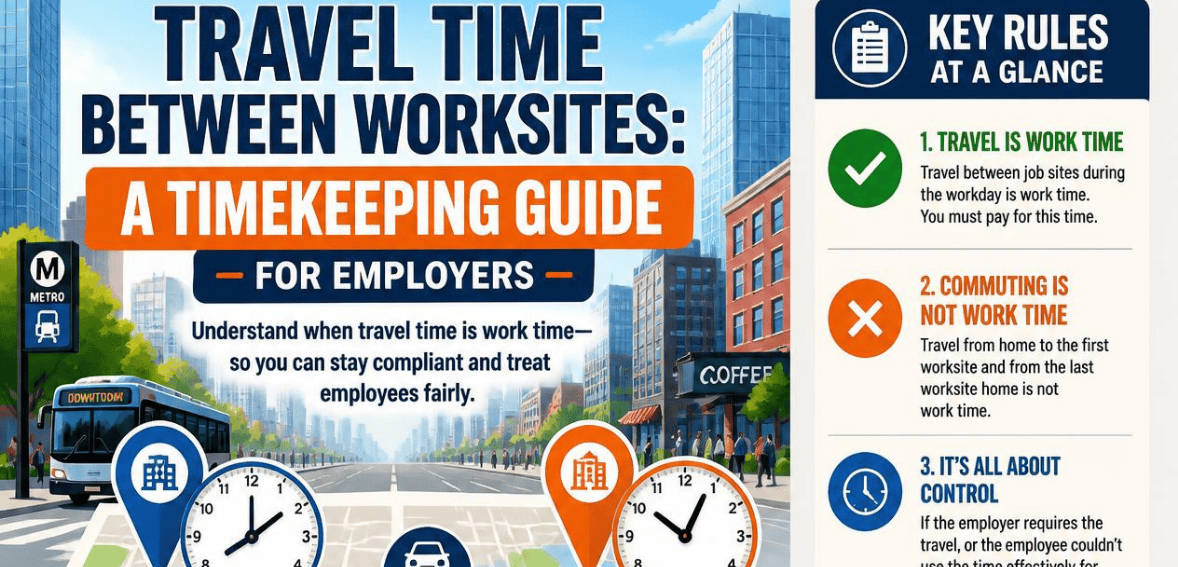
Your electrician clocks in at the shop. Then she drives 40 minutes to a job across town. After lunch, she heads to a second site. Do you have to pay her for that drive time? The short answer is yes. And getting it wrong can cost you.
Travel time between worksites is one of the most confusing corners of wage-and-hour law, and it trips up experienced employers as often as new ones. The rules look deceptively simple: an ordinary ride to your normal workplace is unpaid, while travel performed as part of the job is paid. The trouble is where that line actually falls, and payroll errors cluster right there.
This guide clarifies the legal obligations. Trips that must and must not be paid will be identified, as well as methods for calculating pay rates and recordkeeping that is audit-proof.
What Counts as Travel Time Between Worksites?
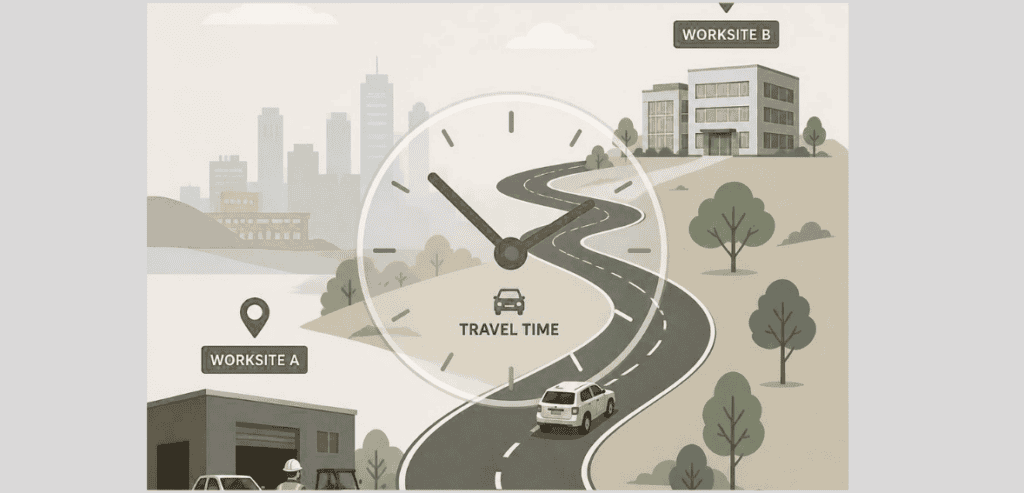
Travel time for worksites applies to non-exempt employees traveling to multiple worksites during the same workday. Think of home health aides traveling between patients, service technicians going to the next customer location, or construction workers going from the main yard to the construction site to get the tools.
This is not the same as a regular commute. A regular commute is going from home to the first location of the workday and from the last work location of the day back home. Travel between worksites occurs after the workday has already commenced. This is the most important difference.
This applies to non-exempt employees, or hourly employees who are covered under federal overtime law. Salaried employees who are exempt from overtime are generally paid the same salary regardless of the hours worked, so travel time and pay rarely apply to these employees.
The Legal Framework: FLSA and the Portal-to-Portal Act
Two federal laws set the ground rules for travel time between worksites.
First is the Fair Labor Standards Act (FLSA). It states all hours worked by non-exempt employees must be compensated. It additionally states that employees who work over 40 hours in a workweek must be compensated for overtime.
Next is the Portal-to-Portal Act of 1947. It was passed to eliminate lawsuits for travel and preparatory time. It states that employers are not obligated to compensate employees for an ordinary commute from home to work, even if the work assignment changes on a daily basis.
The details of both Acts are explained in the Department of Labor regulations, 29 C.F.R. Part 785. The clearest rule is that the ordinary commute remains unpaid. But once the workday has begun, several distinct travel scenarios do require compensation, and they are the ones worth knowing in detail.
U.S. Department of Labor (DOL)
The DOL’s Wage and Hour Division administers and enforces the FLSA, and publishes the formal guidance most employers reference. When real life disputes arise, the first places to turn are the DOL opinion letters and DOL fact sheets. You may review travel time regulations on the eCFR for 29 C.F.R. Part 785. This is the primary source for each point made in this article.
When Travel Time Between Worksites Is Paid

Here is the part employers most often get wrong. Once the workday starts, most travel during it is on the clock. Let’s walk through the main scenarios.
Site-to-Site Travel During the Workday
This is the basic principle. When a worker travels from one job site to another during the workday, that travel is work time. It does not matter if the travel is between two job sites of different customers or the same one.
There is a matching principle for travel to a meeting point. For instance, if a worker is required to report to your shop to retrieve company equipment or receive the work assignment for the day, the workday travel time from the shop to the job site is work time. This is because the employee has begun the workday by reporting to the shop.
This principle is related to the continuous workday doctrine. This principle states that work time begins when the employee performs the first primary work task of the day and continues until the last work task is performed. Travel for work within this time period is work time.
Special One-Day Assignments in Another City
Sometimes you send an employee to another city for a single day. Maybe it’s a client visit, a training session, or a one-off project. That travel time is compensable.
There is a small offset here. You may subtract the employee’s normal commute time from the total. If the round trip took six hours and the usual commute is one hour, you can pay for five. Many employers skip the offset to keep things simple, and that is fine too.
Overnight Travel Away From Home
There’s a unique logic behind overnight trips. For trips that have an employee away from home overnight that also fall during working hours, the employer pays the employee. What tends to surprise people, however, is that those hours are counted even if it’s during the weekend.
Say an employee normally works Monday to Friday, 9 to 5, and has to fly out on a Saturday for a Monday project. Any travel she does that Saturday between 9 and 5 is compensable, because it falls within her normal working hours, even though Saturday is not a workday. Travel outside those hours, when she is simply riding as a passenger and doing no work, is generally not compensable. Bona fide meal breaks may be deducted from travel time.
Work While Traveling and Emergency Callbacks
Two more situations round this out. Any actual work an employee does while traveling is always paid. Answering emails, taking client calls, or driving coworkers as a required part of the job all count as hours worked, no matter the time of day.
Emergency callbacks work the same way. If you call an employee back to a job site after hours to handle an urgent problem, that travel is compensable.
When Travel Time Is Not Paid

The exception you already know about is the ordinary home-to-work commute, which is not compensable. Employees are not compensated for driving to the first job site from home, nor for driving home from the last job site. This applies even if the employee must report to different job locations each day.
A formal policy applies to company vehicles. The Employee Commuting Flexibility Act of 1996 provides that an employee is allowed to use an employer-provided vehicle for a work commute and for driving home without incurring a compensation liability. The employee’s use of the vehicle must be for a work commute and be covered by a written agreement with the employee. It must also be within the normal commuting area.
There is one more consideration. A time period that an employee is completely released from job duties and allowed to use time for personal purposes is also not compensated. An employee who uses this time to run personal errands is also not compensated for the time spent driving.
How to Pay for Travel Time Between Worksites
Knowing travel is paid is only half the job. You also have to get the rate right.
By default, compensable travel is paid at the employee’s regular hourly rate. It also gets added to their weekly hours. That matters, because travel can push someone past 40 hours and into overtime territory.
You have some leeway with the rate. You can lower the rate for travel time provided the rate is at least minimum wage, the employee agrees to the lower rate in writing in advance, and it is stated in policy and not some surprise deduction on the paycheck.
Now for the tricky part, overtime. If an employee earns different rates during the same week, you cannot simply pick one of them for the overtime calculation. You have to use a weighted average, or blended rate, for that week. You calculate the total remuneration for the week and divide it by the total number of hours. You then arrive at the blended rate for the week and the overtime is to be assessed on that rate.
Travel can quickly trigger additional overtime. For example, if an employee worked a standard week of 40 hours and then had to travel to another work site and worked an additional 4 hours of travel time, the employee now is owed overtime on the last 4 travel hours.
Recordkeeping Best Practices for Employers
Good records are your best defense. The FLSA requires you to track hours worked for every non-exempt employee, and travel time between worksites is part of that total.
Configure your timekeeping to allow for the logging of travel time distinct from time worked at a job site. Distinct logging simplifies the calculation of overtime and provides a documented trail that can help address a travel time complaint if one is brought. A documented travel-pay policy also assists. Include a travel-pay policy in your employee handbook and require employees to confirm their receipt and understanding of the policy.
The Department of Labor specifies minimum time frames for the retention of pay records. Pay records should be retained for a minimum of three years. Records that provide details of the calculation of pay, such as time cards and work schedules, should be retained for a minimum of two years.
Precise records do more than just meet an auditor’s expectation. They guard against the two biggest financial exposures of paying too little for travel time that should be paid and miscalculating overtime due. Both can result in significant back pay obligations and fines, as well as the added expense of defending a lawsuit.
State Laws Can Raise the Bar
State laws may exceed federal laws. The Fair Labor Standards Act (FLSA) describes the minimum guidelines that govern payment for travel.
California travel pay laws create greater exposure for employers. California has a unique standard where travel may be considered compensable where it would not be under federal guidelines. California has exposed employers to claims for compensation for mandatory company shuttle services and for travel to off-site company parking. Other states have different travel laws.
An employment attorney can review the applicable state standards quickly and identify which rule is more favorable to the employee. Examine the law for every state your employees actually work in. It is vital to have a clear understanding of the travel pay laws of the states your employees travel to on a regular basis.
Conclusion
Travel time between worksites comes down to one core idea. The commute is unpaid, but once the workday begins, most travel during it is working time. Site-to-site trips, one-day out-of-town assignments, overnight travel during work hours, and any work done on the road all belong on the clock.
Get the classification right. Add travel hours to the weekly total. Use a blended rate when travel triggers overtime. Keep clean records for the required retention periods. And check your state rules, because many go beyond the federal minimum.
Handled well, travel time is just another line on the timesheet. Handled poorly, it becomes a wage claim. A little diligence now keeps your payroll accurate and your business protected.
Frequently Asked Questions
Do I have to pay employees for driving between job sites during the day?
Yes. Travel from one worksite to another during the workday is compensable working time for non-exempt employees. It counts as hours worked and must be included when calculating overtime. Only the ordinary home-to-work commute at the start and end of the day is unpaid.
Can I pay a lower rate for travel time than for regular work?
Yes, within limits. You can set a separate travel rate as long as it meets or exceeds minimum wage and the employee agrees to it in writing in advance. If the week includes overtime, you must calculate the premium using a weighted average of both rates, not the travel rate alone.
Is overnight travel time always paid?
No, not all of it. Overnight travel is paid when it falls during the employee’s regular working hours, including the matching hours on weekends. Travel outside those hours, when the employee is simply a passenger and doing no work, is generally not compensable. Any actual work performed while traveling is always paid.
Do state laws change these rules?
They can. The FLSA sets a national baseline, but states like California impose stricter standards that make more travel compensable. When state and federal rules differ, follow the one more favorable to the employee, and review the specific rules in every state where your employees perform work.