
One missing time punch can cost you thousands. Picture a wage claim that hinges on a single Tuesday. An employee says they never got their lunch. Your records show a gap, but no clear start and stop time. Suddenly the burden is on you to prove a break happened. This is the quiet risk buried inside every timecard.
The distinction between a meal period vs short rest break may seem slight. However, it really isn’t. It affects your costs, your recordkeeping responsibilities, and your litigation risk. The distinction between meal periods and rest breaks may be the most critical aspect of wage and hour recordkeeping. This guide explains what employers must keep records of and the significance of the distinction.
What Is the Difference Between a Meal Period vs Short Break?
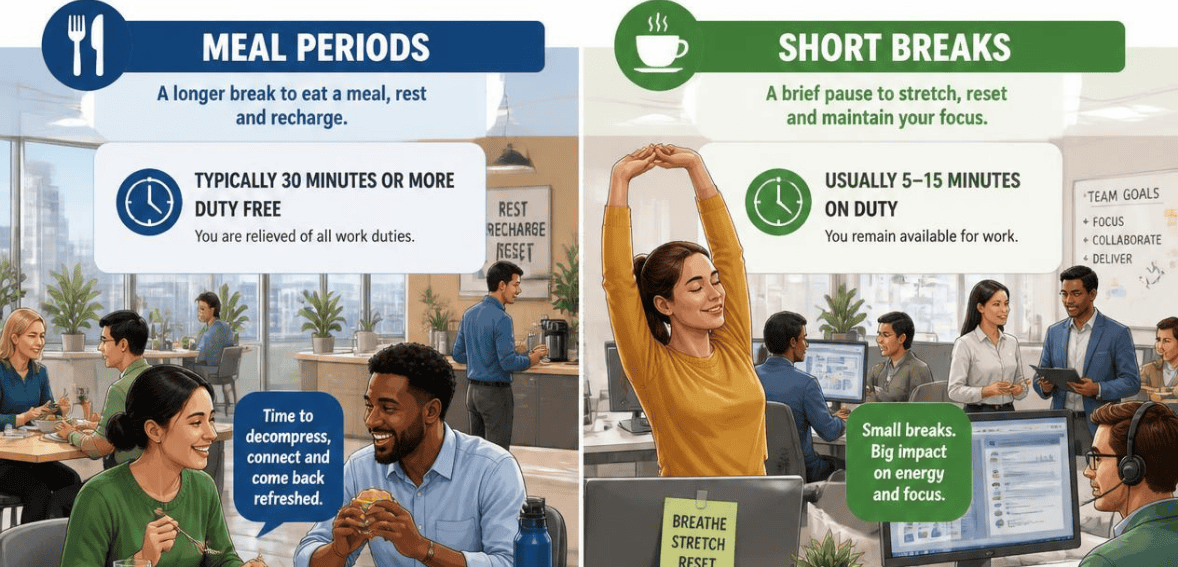
A short break is a brief pause you can take during your workday. These breaks can involve grabbing a coffee or snack, or even just stepping away from your desk for a moment. A short break tends to last between five and twenty minutes, but a meal period is longer. A meal period can last for thirty minutes or more and is meant for the employee to “eat” and “recharge.”
Short breaks and meal periods are also treated differently when it comes to pay. According to federal law, a short break is still considered part of the workday. A meal period, however, is considered personal time. This is how a break period payment system is determined. Once you understand the system of breaks and meal periods, the other time-tracking requirements become a lot clearer.
Why Federal Law Treats Meal Periods and Short Breaks Differently
Here is the surprise that catches many business owners off guard. Federal law does not require you to offer any breaks at all. The Fair Labor Standards Act (FLSA) does not mandate meal periods or rest breaks for adult employees. What the FLSA does regulate is how you treat break time once you choose to provide it.
The rules relate to time. Paid time breaks of 20 minutes or less must be made. Time breaks that are 20 minutes or less must be counted as time worked and must be paid. Additionally, this time counts toward the 40 hours worked in the workweek over which overtime pay must be calculated. It is prohibited to deduct this from a future paycheck or to not pay it.
Time is also reversed for meals. Breaks of greater than 30 minutes can go without pay, but the employee must be free from and relieved of all work duties for that time. It must be an uninterrupted meal break period to truly be a break. If all of these conditions are met, this period is not considered work time and must not be compensated.
The 20-to-30 Minute Gray Zone
What about a break that lands between 20 and 30 minutes? This is the murky middle. Federal guidance is not crisp here, and courts have room to interpret. Payroll experts generally agree on the safest move. Pay for that time. A 25-minute break treated as unpaid is a claim waiting to happen. When you are unsure, err toward paying. The cost of paying a few extra minutes is far smaller than the cost of a wage dispute.
When a Meal Period Becomes Paid Time

An uninterrupted break means an unpaid break. This changes the moment work interferes with the break. If an employee takes a work-related call or message or returns to work to cover their station during a lunch break, then that break is no longer a legitimate break and compensable work time is no longer lunch break time.
This affects more employers than almost anything else. The majority of American workers eat their meals at their desks. Many are half-paying attention to their emails. If your employees are on lunch but, are in reality, still working, then you definitely owe them for that work. Even a single task can change an unpaid 30-minute workday lunch break to a paid lunch break. The difference between a meal period and a rest period is completely erased when an employee is not completely relieved of duty.
There is a really simple solution to this. An unpaid meal period must actually be a meal period. This means no work, no monitoring, no standing by. If you cannot provide this, assume the time is paid.
State Laws Add Another Layer on Top of the FLSA
The FLSA sets a federal floor, not a ceiling. Many states go further and require breaks that federal law does not. Where state law is stricter, state law wins. When an employee is covered by both, they get the most generous protection available. This is where multi-state employers get into trouble.
Some states require a paid rest period for every few hours worked. Others mandate a meal break once a shift passes a certain length. A policy that is perfectly legal in one state can be a violation in the next. If you have workers in more than one state, you cannot run a single national break rule and hope for the best. You have to map each state where people actually perform work.
California: The Strictest Example
California deserves its own mention as it has one of the most demanding workplace regulatory environments. In California, a mealtime break must be taken by employees within five hours of the start of the work shift, with a second break becoming necessary when a shift exceeds ten hours. The law also requires paid rest breaks of at least ten minutes for every four hours (or major portion) of work.
There is a very real and financial penalty for breaks that are missed. Employers must pay an hour of the affected employee’s work rate for violations of the mealtime break requirement. There is a separate penalty of an hour of pay for violations of the rest break requirement. If both breaks are missed, the employer is liable for two hours of pay for the employee. Given the number of employees most employers have, the total cost of violations can very easily reach the six figures.
California also has an effective and powerful legal presumption. If a break is missed and the time is simply recorded, California law presumes that a violation of the time break law has occurred. It can only be disproved with good records. No time is no proof. This is why jurisdictions require thorough time documentation.
What Employers Need to Track for Wage-and-Hour Compliance
This is the heart of the matter. Meal periods and rest breaks do not carry the same tracking burden, and knowing which is which saves you real headaches.
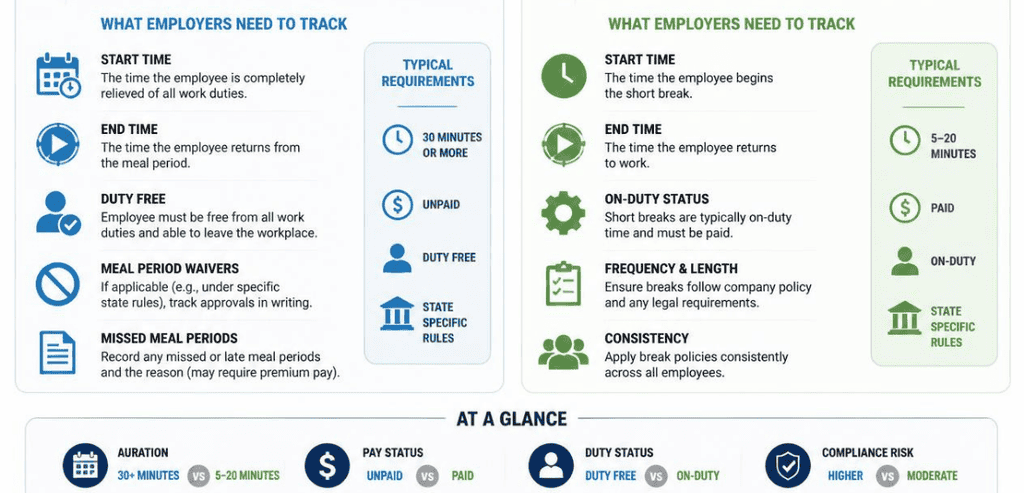
Generally, you can incorporate short paid rest breaks into working hours. Since they’re paid, there’s no adjustment to defend. In contrast, meal breaks are unpaid and thus must be justified. This requires the recording of clear start and end times, down to the minute, for all meal breaks.
Non-exempt employees should be required to clock out for unpaid breaks and then clock back in upon return. This ensures that the meal break was, in fact, taken and also serves to confirm the break was taken on time and prior to the legal meal break deadline in those states that require it. This practice also confirms the break was taken on time. There’s a prevailing trend that rounding is becoming less and less acceptable. Therefore, this practice should be to the minute, rather than rounded.
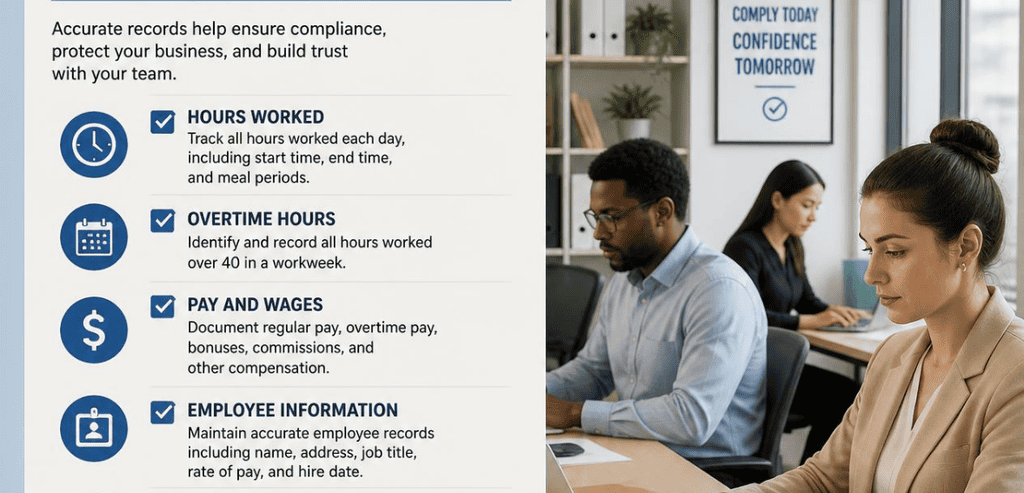
Record retention is also important. Under the FLSA, time records and payroll records must be retained for a period of no less than three years, and some states require them to be retained for a longer period of time. California and a handful of other states require a four-year retention of time records due to the longer reach of wage claims against employers. Longer records, not shorter, should be your practice. A deleted time record eliminates your defense.
Common Mistakes That Trigger Wage Claims
The automatic meal deduction is a costly mistake. Many payroll systems deduct 30 minutes for lunch every day. If the system reduces pay, assuming the employee takes the full lunch break, there is no issue. However, if an employee takes a lunch break and works through it, that can quickly become a lawsuit. If you’re using automatic meal deductions, provide a way for your employees to stop deductions in the case of a lunch break not taken or a lunch break not interrupted. The Department of Labor has cited this specific example with healthcare employers.
Another example is discouraging employees from reporting time worked, lunch taken, breaks taken, etc. If an employee is working through lunch in violation of your company’s lunch policy, the employee is still owed pay for the work performed. Appropriate employee policy action can be taken, but if you’re not paying for the time worked, you’re incurring liability for not paying.
Conclusion
The line between a meal period and a short break is small on paper but huge in practice. Short breaks of 20 minutes or less are paid and easy to handle. Meal periods of 30 minutes or more can be unpaid, but only when the employee is truly off duty, and only when you can prove the break happened. That proof lives in your records.
Master the meal period vs rest break distinction and most of your wage-and-hour risk shrinks. Pay short breaks. Track meal periods to the minute. Check every state where your people work. Keep records for at least three to four years. Give employees a clean way to report missed breaks, and honor it. Do those things consistently, and that scary Tuesday timecard gap stops being a threat. It becomes just another well-documented day.
Frequently Asked Questions
Does federal law require employers to give lunch breaks?
No. The FLSA does not require meal periods or rest breaks for adult employees. It only regulates how break time is treated when you choose to provide it. Some states, however, do require breaks, so you must check the laws in every state where your employees work.
Are short breaks paid or unpaid?
Short rest breaks of 20 minutes or less must be paid under federal law. That time counts as hours worked and toward overtime. Meal periods of 30 minutes or more can be unpaid, but only if the employee is completely relieved of duty.
Do I have to track short rest breaks separately?
Usually no. Because short breaks are paid, they fold into regular work hours and do not need their own record. Unpaid meal periods are different. You should record a clear start and stop time for each one so you can prove the break was actually provided.
What happens if an employee works through an unpaid lunch?
That time becomes paid work time, even if working through lunch violated your policy. You must compensate the employee for the hours worked. You can handle the policy issue separately, but you cannot withhold pay for time that was actually worked.