
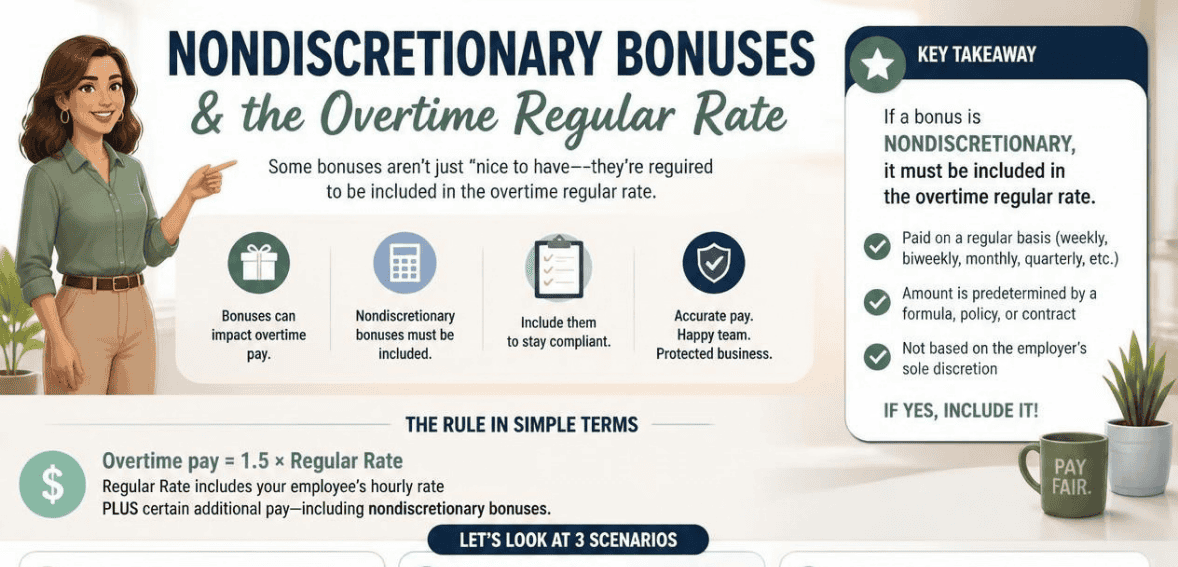
You paid your team a performance bonus. You feel good about it. But here’s the part that trips up thousands of employers every year: that bonus may have just changed how much overtime you legally owe. Miss the math, and you could be underpaying workers without even knowing it.
Nondiscretionary bonuses are linked to the regular rate of pay for calculating overtime. Many think that nondiscretionary bonuses affect the regular rate of pay because bonus payments and overtime pay are linked. In this guide, we cover what a nondiscretionary bonus is and how you should account for the regular rate of pay for calculating overtime.
What Is a Nondiscretionary Bonus?

A nondiscretionary bonus is a payment your employees can reasonably expect to receive. It’s promised in advance, tied to a formula, or connected to a goal. Think production targets, sales quotas, attendance streaks, safety records, or a promise to pay if a project ships early.
The important part here is what employees expect. Once the bonus program is communicated and employees understand the bonus criteria, the bonus is, for all intents and purposes, nondiscretionary. From a legal standpoint, the terminology that is used is irrelevant. For example, if a company is using the term ‘discretionary reward’ in the employee handbook, and the bonus system is guaranteed or based on a formula, then this is not a discretionary bonus.
Discretionary bonuses operate differently. The employer determines if a bonus will be issued, the bonus amount, and the distribution date. This is done at the end of the period with no prior promise to employees. A surprise bonus in the form of an employee gift is a typical example. This type of bonus is not included in the calculation of overtime pay. Nondiscretionary bonuses, on the other hand, are included in the calculation of overtime pay.
What Does the “Regular Rate of Pay” Actually Mean?
Most employers assume the regular rate is just the base hourly wage. That assumption causes real problems.
Compensation covered by the Fair Labor Standards Act (FLSA) includes a variety of forms of an employee’s compensation for a workweek, and the forms of compensation that are part of the employee’s compensation for the workweek include base pay, shift differentials, commissions, and nondiscretionary bonuses. In general, payment that constitutes a true gift or certain contributions to a company’s profit-sharing plan can be omitted from compensation.
The Fair Labor Standards Act (FLSA) does not establish a single defined Regular Rate. For a workweek that includes a nondiscretionary bonus, the Regular Rate is the value of the bonus plus the compensation the employee earned for the week. Overtime obligation is calculated as time and one-half the value of the Regular Rate.
The U.S. Department of Labor’s Position
The U.S. Department of Labor (DOL) has been consistent that the enforcement of the Fair Labor Standards Act (FLSA) requires nondiscretionary bonuses to be added to the regular rate for the calculation of overtime premiums. As always, the DOL opinion letters provide us with insight on the issue. This time, in the January 2026 opinion letter, the DOL explains that once a bonus has been determined to be earned and measurable, the employer has lost discretion over the bonus and it becomes part of the regular rate. The DOL has put together a free Fact Sheet #56C. It outlines the rules and contains examples that are worth reading before your upcoming bonus distribution.
Why a Nondiscretionary Bonus Raises the Overtime Regular Rate
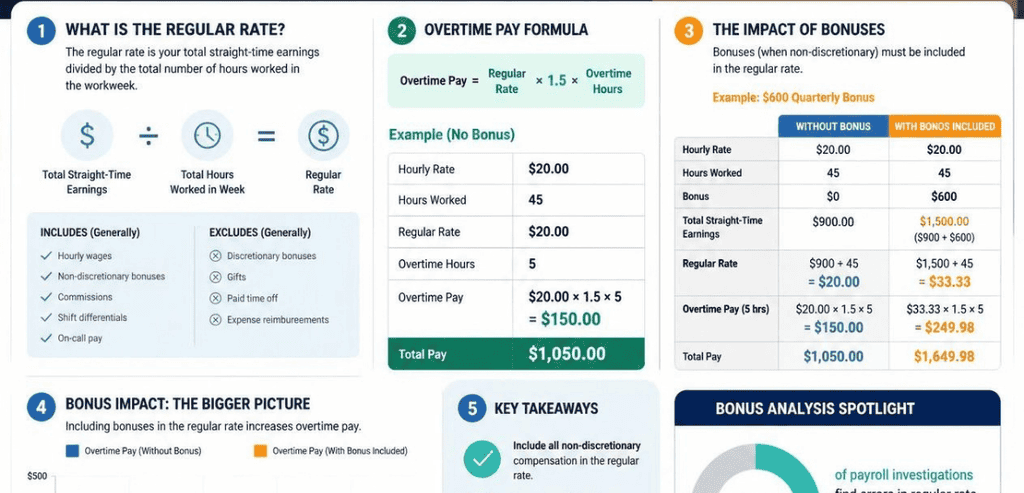
Here’s the logic in plain terms. Overtime pay exists to compensate employees fairly for extra hours. To do that fairly, the law says overtime must reflect everything the worker earned, not just the base wage.
When a bonus recognizes a worker’s effort, work, or hours, it’s something the worker earned. Not incorporating it into the overtime calculation would mean the employer would be denying what the worker is due for the overtime done. Therefore, the FLSA would mandate the employer to spread the bonus over the hours worked, think of the regular rate anew, and pay an extra overtime premium on top.
As a result, the same base wage can create different overtime rates in the same or different weeks. A week in which a bonus is earned or paid would have a higher regular overtime rate than a week in which no bonus is earned or paid. Your payroll system is obligated to account for this every single time.
How to Calculate Overtime With a Nondiscretionary Bonus
The method is often called the “half-time” adjustment. It sounds technical, but it follows a simple path. You find total earnings, divide by hours worked to get the regular rate, then add an extra half-time premium for each overtime hour.
A Simple Weekly Example
Say an employee earns $20 an hour. In one workweek, they work 48 hours. They also earn a promised $120 production bonus for hitting a target that week.
Let’s calculate straight-time pay first. Straight-time pay for 48 hours at $20 per hour equals $960. The bonus is added next: $960 plus $120 equals $1,080, total for the week. To calculate the regular rate, total earnings are divided by total hours. $1,080 divided by 48 hours equals $22.50 per hour. $22.50 per hour is the regular rate, which is the new base rate for the bonus pay.
Now to calculate how much is owed for overtime. The employee worked 8 hours of overtime. The straight-time pay covers all hours worked, so only the half-time premium is owed for the overtime worked. The premium is half of $22.50, which is $11.25. $11.25 times the 8 hours worked equals $90. The total owed to the employee for the week is $1,170.
Leaving the bonus out would have understated that premium by $10 for the week. For many employees, over multiple pay periods, this practice adds up to a significant amount.
When the Bonus Covers More Than One Week
Not every bonus lines up neatly with a single workweek. Quarterly bonuses, annual production bonuses, and multi-week incentives are common. These need a backward look.
When a nondiscretionary bonus covers a longer stretch, you must apportion it back across the workweeks it was earned in. Then you recalculate the regular rate for each of those weeks and pay any additional overtime that comes due. If the bonus can’t be tied to specific hours, the DOL allows employers to spread it evenly across the workweeks in the bonus period, or across the hours worked, depending on the arrangement.
The FLSA offers some leeway on timing issues. If you are unable to determine the amount of a bonus until the end of the period, you are not required to do an overtime recalculation before the end of the period. However, once the bonus amount has been determined, you are required to do the recalculation. The DOL’s Fact Sheet #56A on the regular rate of pay is a good resource for examples on the general principles of the regular rate.
Discretionary vs Nondiscretionary Bonuses: Getting the Line Right
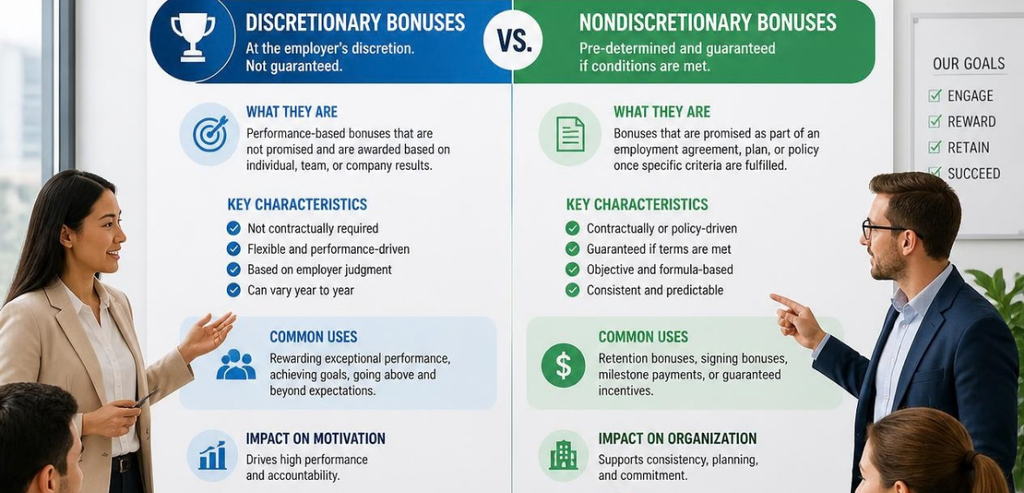
Since the whole calculation hinges on this distinction, drawing the line correctly matters more than almost anything else.
A bonus is nondiscretionary if employees can reasonably anticipate it. Bonuses for production, attendance, safety, and quality, as well as any bonus that is communicated in advance to encourage employees to exert more effort, are all nondiscretionary. They are included in the regular rate.
You have discretion over a bonus if you control the decision to grant a bonus, the amount, and the decision is made at the end of the period, with no promise made beforehand. This is a limited category, and the DOL takes this category to be limited. A year-end bonus may be discretionary, but if you provide a fixed amount or if the bonus is determined by a set formula, employees will expect the bonus. In that case, the bonus may be classified as nondiscretionary. To ensure the bonus remains discretionary, you must explicitly describe the bonus as discretionary and in writing, each time. Also, do not relate the bonus to any promise or performance measure.
Common Mistakes Employers Make
The biggest error is treating the base wage as the regular rate. As shown above, the regular rate almost always sits higher once a nondiscretionary bonus enters the picture.
Mislabeling is another common error. Employers think that because they chose to give a bonus, the bonus is discretionary. However, discretion over whether to create a bonus program is not the same as FLSA discretion. If the bonus is promised or driven by a formula, it falls into that category.
The third error is not taking a backward look for multi-week bonuses. A failure to revisit the overtime weeks for a quarterly bonus is a textbook audit issue. DOL investigators and plaintiff’s attorneys know exactly how to find the big issues, and unpaid overtime spikes can very rapidly be created across a number of employees.
Recordkeeping and Compliance Tips
Good records are your best defense. Track total hours worked each workweek, the base rate, and every bonus paid, along with the period each bonus covers. That paper trail lets you recompute the regular rate accurately and prove you did.
Before announcing any bonuses, coordinate with Payroll. Tell your Payroll staff or provider whether the bonus is discretionary or nondiscretionary, and what period it covers. This one communication solves most challenges and supports compliance with the FLSA’s recordkeeping requirements, which are the foundation of any wage and hour program.
Lastly, keep in mind that federal law is the minimum standard, and state law can be more stringent. Some states have their own overtime regulations with daily thresholds for overtime. Always review your state regulations along with the FLSA to remain compliant at the higher standard.
Conclusion
A nondiscretionary bonus is more than a thank-you. Under the FLSA, it becomes part of your employees’ earnings, which means it directly raises the overtime regular rate. Get the classification right, fold the bonus into the regular rate, and pay the extra half-time premium on overtime hours. Do that consistently, keep clean records, and loop in payroll early, and you’ll stay on the right side of federal law.
The math is not hard once you see it in action. The risk comes from ignoring it. When you understand how a nondiscretionary bonus and the overtime regular rate connect, you protect your business, pay your team fairly, and sidestep one of the most expensive mistakes in wage-and-hour compliance.
Frequently Asked Questions (FAQs)
Do I have to include every bonus in the overtime regular rate?
No. You only include nondiscretionary bonuses, meaning bonuses your employees expect, are promised, or earn through a formula or goal. Truly discretionary bonuses, where you control both the decision and the amount with no advance promise, can stay out of the regular rate.
How does a nondiscretionary bonus actually change my overtime pay?
The bonus adds to total earnings for the workweek. When you divide those higher earnings by the hours worked, the regular rate rises. Since overtime is time and one-half the regular rate, your overtime premium rises too. You then owe an extra half-time premium on each overtime hour.
What happens with quarterly or annual bonuses that cover many weeks?
You apportion the bonus back across the workweeks it was earned in, recalculate the regular rate for each week, and pay any additional overtime due. If you can’t determine the amount until the period ends, you may wait, then true up the overtime once the figure is known.
Can I avoid this by calling a bonus “discretionary” in my handbook?
No. The label does not control the outcome. If the bonus is promised, expected, or tied to performance metrics, the DOL treats it as nondiscretionary regardless of what you call it. Only genuine discretion over both the payment and the amount keeps a bonus out of the regular rate.