
Most employees think their workday starts when they clock in. Most employers think the same thing. Both are often wrong.
Starting a computer, putting on safety equipment, waiting for a handoff report, delivering a package to a truck after clocking out. These minor activities may seem inconsequential. However, the federal wage law treats some as paid work and some as not. Drawing the line incorrectly is one of the quickest ways for a company to receive a back-pay claim. This guide will help you understand what is covered as pre-shift work time and post-shift work time, the challenges pre-shift work time presents to payroll, and how to maintain good records.
Why Pre-Shift Work Time Matters More Than You Think
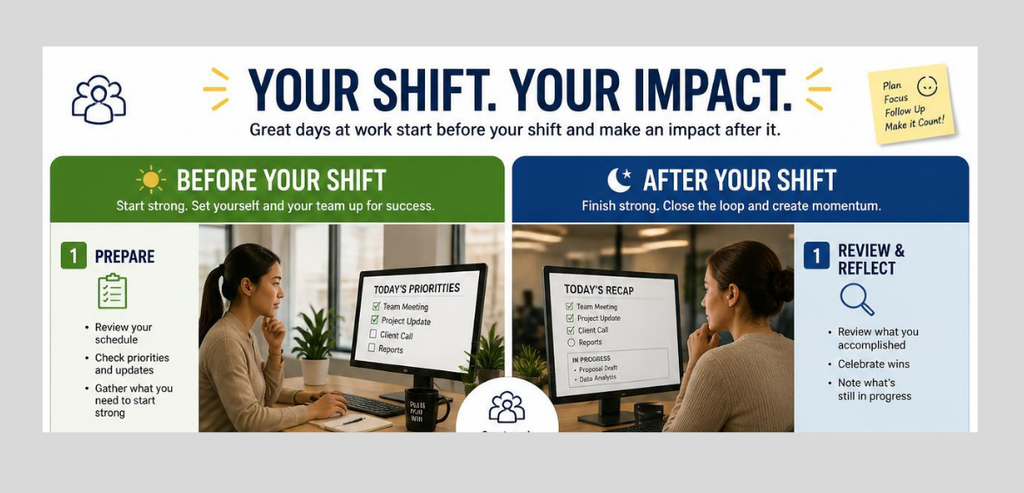
The stakes here are bigger than a few minutes a day. Multiply five unpaid minutes by every worker, every shift, across a full year, and you get real money. Class and collective actions under the Fair Labor Standards Act (FLSA) are built on exactly these small increments.
This is fundamentally a recordkeeping issue as well. Advanced timekeeping systems round early arrivals up to the scheduled start time, even though employees start work well before that time. A timekeeping system in this configuration is not capturing accurate data for time worked. Accurate data for time worked is critical for wage-and-hour compliance. If this data is not accurate, compliance with minimum wage and overtime regulations is at risk.
The Legal Backbone: FLSA and the Portal-to-Portal Act
The 1938 FLSA established a couple of foundational rules. First, all covered, non-exempt employees must be paid at least a minimum wage for all hours worked. Second, they must be paid for overtime at a rate not less than time and one-half of their regular rate. The limitation on the definition of “hours worked,” however, does a considerable amount of work.
Congress responded to a burst of lawsuits in the late 1940s over compensation for “walk time” and similar claims by enacting the Portal-to-Portal Act in 1947. The Act established strict lines. Time spent on normal commuting is not compensated. Time spent on “preliminary” and “postliminary” activities is also not compensated. The purpose of the Act was to relieve the burden on employers of owing wages for every moment of time spent in connection with employment.
But the Act left an important door open. If a pre- or post-shift task is truly part of the job, it still counts. That opening is where most modern disputes live.
U.S. Department of Labor
The Wage and Hour Division of the U.S. Department of Labor (DOL) oversees the enforcement of the Fair Labor Standards Act (FLSA) and accepts and investigates allegations, conducts employer audits, and issues opinion letters articulating the application of law to unique circumstances and situations. The Division published new guidance in 2026 on the workplace status of pre-shift duties and commute time. The Division applies a “primary beneficiary” test. The main question of the test is simple: was the time in question primarily for the benefit of the employer or the employee? Employers interested in the DOL’s current official view should start with the DOL’s Fact Sheet #22 on Hours Worked.
Preliminary and Postliminary Activities Explained
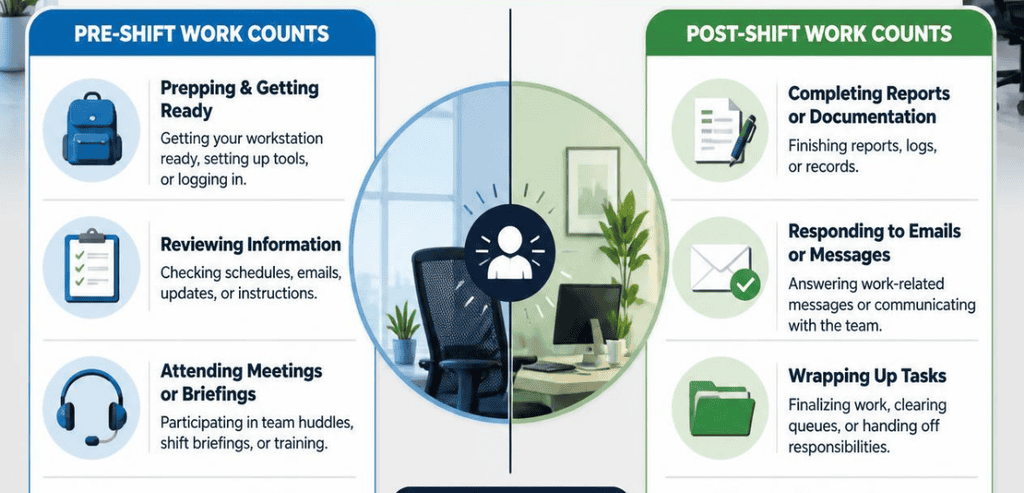
Preliminary activities happen before an employee starts their principal duties. Postliminary activities happen after those duties end. Think of the tasks that bookend a shift rather than the work itself.
Non-compensable examples include, but are not limited to, walks from the parking lot to the workstation, clock-punching line waits, and pre-shift coffee runs. All of these activities occur outside of the workday. None of these examples are activities that are part of the employee’s work responsibilities. Getting the correct label is critical for this type of work. The Portal-to-Portal Act will generally keep work that is labeled as preliminary or postliminary off the clock.
The trouble is that many real-world tasks refuse to sit neatly in that box.
The “Integral and Indispensable” Test
Here is the rule that applies to close cases. Work done before or after a shift is compensated if it is “integral and indispensable” to an employee’s main work functions. Simply stated, a task is part of the job if it must be done prior to performing a main work function.
The Supreme Court refined this concept in Integrity Staffing Solutions, Inc. v. Busk in 2014. The Court dismissed the request of warehouse employees to be compensated for time spent undergoing security screenings at the end of the work shift. The Court held that the screenings were postliminary and, as such, were not intrinsic to the employees’ work of retrieving and packing warehouse items. Therefore, the employer was not required to pay employees for that screening time.
The earlier landmark case, Steiner v. Mitchell, involved employees of a battery plant who were exposed to hazardous materials. In this case, changing clothes and showering before and after the work shift was required to safely perform the work. The time for this activity was deemed compensable as it was part of the main work function. The key distinction in the two cases is the difference between “connected to the job” and “part of the job.”
What Usually Counts as Pre-Shift Work Time
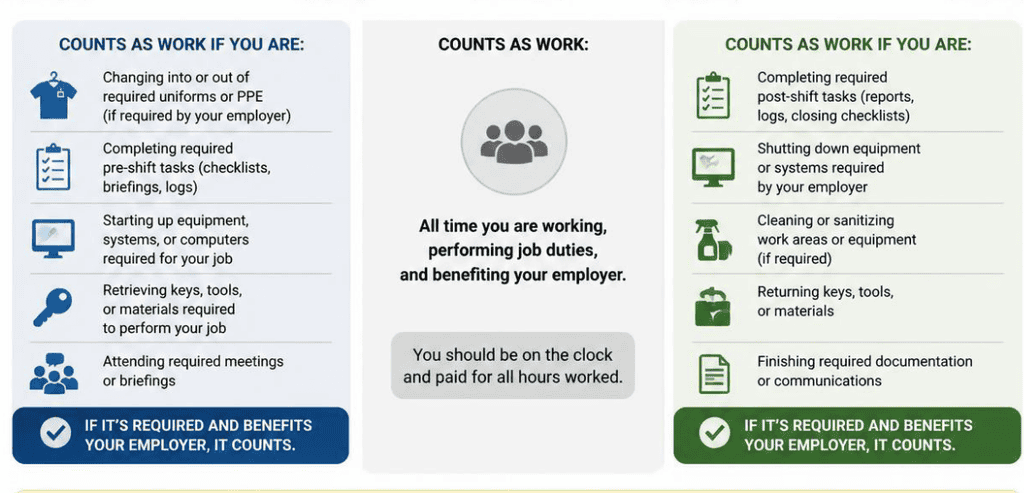
Some tasks are undoubtedly paid. For example, donning and doffing job-related, specialized protective equipment, like in the manufacturing and meatpacking industries and in other environments with industrial and other types of hazardous exposure, is paid. The same is true for sharpening tools at the start of the shift in butchery. It is also the case in the healthcare field for receiving a patient-status handoff report, because the nurse or therapist cannot begin patient care without that report. Logging into the required systems and the first customer-call software also falls within this scope of paid tasks.
The common denominator for all of these tasks is that they are required to be performed so that the employee can carry out the fundamental tasks of the job. When employers fail to pay for this time, the law treats it as “off-the-clock” work and a basis for legal claims.
What Usually Doesn’t Count
Other early or late tasks will usually remain unpaid. Commuting to and from work, no matter how long or how bad the traffic, will most likely remain unpaid. The time spent waiting to clock in or out is generally unpaid, as it is not essential to the work. General security screenings unrelated to the work will most likely remain unpaid, as confirmed by Busk. It is most likely that the use of optional employer-provided transport and showing up early will remain unpaid.
The term is “most likely.” A written contract, a union agreement, or a long-standing workplace custom can convert otherwise unpaid time into paid time. For example, if your workplace has a long-standing custom of paying for a 15-minute pre-shift setup time, then your workplace must pay you for that time, even if the law does not require it.
The Continuous Workday Rule
Once the first principal activity of the day begins, a helpful rule kicks in. It is called the continuous workday doctrine. From the start of that first real task until the last one ends, the time in between is generally compensable.
This has an important real-world effect. “Changing a safety device,” for example, is a compensable task that starts the workday. The short walk to the production floor is now part of the workday and therefore paid. Activities that would have been unpaid before the workday now become paid once the workday has started. A lot of employers who get that first triggering activity wrong will inadvertently leave employees uncompensated for a whole chain of work-related activities.
The De Minimis Doctrine and Its Limits
Not every stray minute leads to liability. Under the de minimis doctrine, tiny and hard-to-track increments of otherwise compensable time can sometimes be disregarded. The Supreme Court recognized this back in 1946 in Anderson v. Mt. Clemens Pottery Co., noting that trifling amounts of time may be ignored.
Courts weigh three factors. They look at how hard it would be to record the extra time, the total amount of time in the aggregate, and how regularly the work happens. A few seconds here and there, tough to capture and inconsistent, may fall below the line. Substantial or predictable time does not.
Customer Connexx
Cadena v. Customer Connexx LLC illustrates the thinness of the line concerning time-clock obligations. Employees had to start their computers before they could begin to clock in. A federal district court ruled this boot-up time to be de minimis, but the Ninth Circuit reversed that ruling in 2024 and sent the case back for trial. The court noted that the employer had a policy and a method for employees to report and seek compensation for boot-up delays that exceeded the norm.
Employers should not assume that boot-up time is de minimis. Employers should implement policies and corrective processes to address time-clock obligations and maintain honest time records. Written policies alone should not be relied on as a shortcut around actual time-clock obligations. Courts will be very skeptical of those arguments.
State Laws Can Go Further Than Federal Rules
Federal statutes are the minimum requirements for all states. Some states have laws that go beyond those established by the FLSA. California has different and more complex wage-and-hour laws compared to federal laws. Courts in Pennsylvania and Illinois have determined that their state wage laws do not include the Portal-to-Portal Act’s exceptions. As a result, employees may have to be compensated for all time spent on company premises.
When it comes to policies, employers cannot run a single policy for the entire nation and assume it will be adequate for all states. The most legally sound strategy is to create policies that adhere to the most protective standard in all of the states in which they operate. If there is ever uncertainty, it is always best to check the latest policies with the DOL Wage and Hour Division along with the labor division of the respective state.
How Employers Can Stay Compliant
Compliance begins with the understanding of what employees do before work begins and after work ends. Determine the routine of all employees at every level of the organization. Understand what tasks are expected of employees and what tasks are necessary for the job, and what tasks are performed after the last job duty has been completed. Then align your timekeeping system to ensure these time moments are captured and are not automatically rounded.
Having a written policy is generally a good practice but is not a substitute for enforcement. If off-the-clock work is prohibited, you should enforce the policy and allow employees to easily report time that you did not capture. Your time records should be accurate and complete because, in a timekeeping dispute, the burden often shifts to the employer to prove the accuracy of time worked. For answers to general work-time questions in plain language, the DOL’s FLSA FAQ page is a great resource.
Conclusion
The boundary between paid and unpaid time is thin, but it is not a mystery. Ask one question about any task that happens before or after the scheduled shift. Is it integral and indispensable to the actual job? If the answer is yes, it is almost certainly compensable, and your records need to show it. If it is a truly incidental task like commuting or waiting in line to clock in, it likely stays off the clock, subject to state law and your own policies.
Pre-shift work time is where good intentions and sloppy payroll collide. Employers who take the time to map their real workflows, respect the continuous workday rule, and keep clean records will avoid most wage-and-hour headaches. This article is general information, not legal advice, so check with an employment attorney for your specific situation.
Frequently Asked Questions
Is time spent booting up a computer before a shift paid?
It depends. If logging into the system is necessary before the employee can perform their principal duties, that time is generally compensable. However, if the boot-up takes only seconds and is irregular and hard to track, a court may treat it as de minimis. Clear policies and a way to report unusual delays make a big difference.
Do I have to pay employees for their commute to work?
Ordinary home-to-work commuting is not paid under the FLSA, even for long trips. The rule can change once the workday begins. Travel between job sites during the day, for example, is usually compensable. Some states also treat commute-related time differently, so local rules matter.
What is the difference between preliminary and integral activities?
Preliminary activities are incidental tasks that happen before the real work starts, like walking in or waiting to clock in, and they are generally unpaid. Integral and indispensable activities are essential to the job itself, like donning required safety gear, and they must be paid. The test is whether the employee can perform the core job without doing the task first.
Can a company policy make unpaid time into paid time?
Yes. A written contract, a collective bargaining agreement, or an established workplace custom can make otherwise non-compensable time payable. If your business has consistently paid for a certain pre-shift task, that practice can create an obligation even where federal law would not require it.