
Some employees receive a fixed weekly salary even though the number of hours they work changes from one week to another. When carefully structured, federal law may allow an employer to calculate overtime for certain nonexempt employees using the fluctuating workweek method. The overtime premium can appear to be half...
FLSA Workweek vs Pay Period: Why the Difference Changes Over Time
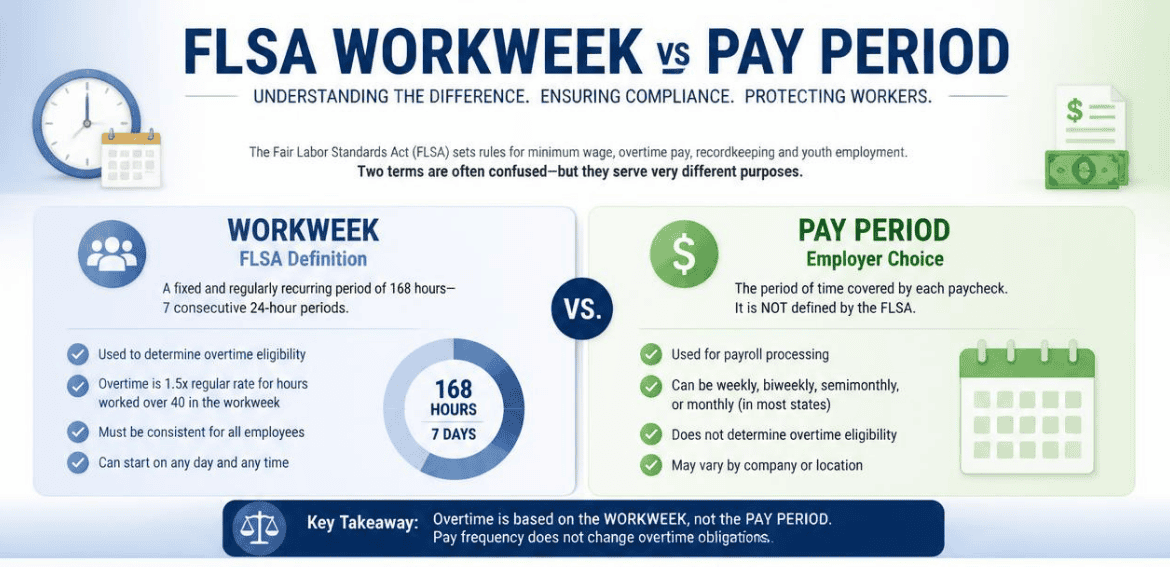
Imagine two employees at the same company. Both work 80 hours over two weeks. Both earn the same hourly rate. Yet one gets an overtime check, and the other doesn't. How? The answer comes down to one of the most misunderstood rules in wage-and-hour law: the FLSA workweek vs pay...
How to Replace a Hardware Time Clock With a Tablet (Step-by-Step)

That fingerprint clock on your wall cost you $300. It's been there for four years, a handful of employees have complained that it doesn't read their fingerprints reliably, and it still doesn't connect to your scheduling software or your payroll system. Every pay period, someone has to export a file,...
On-Demand Pay: What Employees Expect in 2026 (and How to Offer It Without Changing Payroll)

Something has shifted in how hourly workers think about their paychecks. For most of the 20th century, the two-week pay cycle was simply how things worked. You worked, you waited, you got paid. The timing wasn't a benefit or a perk — it was just the structure of employment, and...
Auto-Scheduling vs. Drag-and-Drop: Is There Actually a Difference?
If you've been shopping for employee scheduling software recently, you've probably noticed that almost every vendor leads with drag-and-drop scheduling as a feature. It's become the default selling point, the visual centerpiece of the product demo, the thing that gets managers nodding along during the sales call. And drag-and-drop scheduling...
Minor Labor Laws by State: The 2026 Employer’s Compliance Guide

If your business employs anyone under 18, you're operating under a layer of labor law that many employers underestimate — or don't fully understand until they receive a violation notice. Minor labor laws govern how old a worker must be to do certain jobs, how many hours they can work,...
Offline Time Tracking: What It Is, Why It Matters, and Who Actually Offers It

Picture this: It's 6:45 AM on a job site in the middle of nowhere. Your crew is ready to start. The foreman opens the time tracking app on his phone to clock everyone in — and nothing loads. The cell signal is spotty at best, and the job site WiFi...
Why Your $400 Fingerprint Clock Is Costing You More Than You Think

Let's talk about the fingerprint clock on your wall. You bought it because you wanted to stop buddy punching. Fair enough — that's a real problem. But chances are, that device has quietly become one of the most expensive line items in your HR stack, and not just because of...